Generally speaking, the heat treatment of stainless steel bolts is determined by the hardness of the bolt itself. Common heat treatments include tempering heat treatment Chemical heat treatment and local heat treatment. The first two types of heat treatment are designed as a whole, while the last type of heat treatment is designed for local treatment. No matter which heat treatment method is used, the bolt itself is very important. Different hardness requires different heat treatment methods. Even with the same heat treatment method, the hardness varies depending on the chosen ruler The hardness standards are different.
Three heat treatment methods for stainless steel bolts:
1. Tempering heat treatment: Tempering heat treatment mainly uses induction heating or flame heating. You can use two hardness testers to test the hardness of the bolt and then decide which standard of heat treatment to ultimately choose. These two hardness testers are Vickers hardness tester and Rockwell hardness tester, respectively. In addition to hardness, one can also choose from the thickness of surface heat treatment. For units used for processing or extensively using surface heat treated workpieces, a Vickers hardness tester can be selected; When the surface heat treatment hardened layer is thick, a Rockwell hardness tester can also be used. Different tempering heat treatment standards can be exchanged with each other because their conversion values are internationally recognized. After selecting a hardness tester, different scales should be chosen, namely HRA scale and HRC scale.
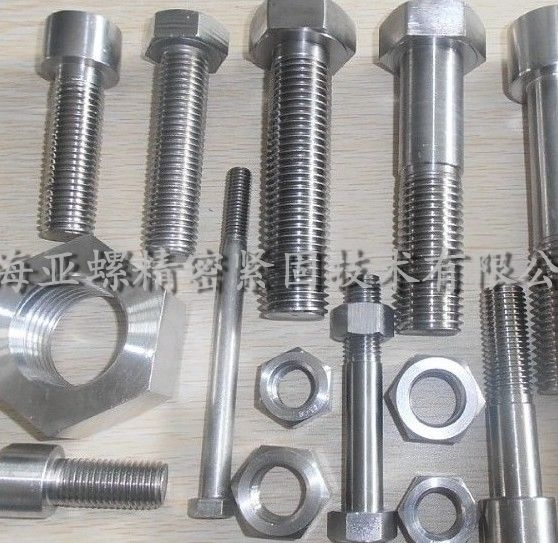
A5-80 stainless steel bolt
2. Chemical heat treatment: Another heat treatment method for bolts is chemical heat treatment, which mainly involves infiltrating atoms of one or several chemical elements into the surface of the workpiece, thereby changing the chemical composition of the workpiece surface What effects can chemical treatment achieve in terms of organization and performance? After quenching and low-temperature tempering, chemical heat treatment can give the workpiece surface high hardness Wear resistance and contact fatigue strength, high toughness of the workpiece core.
3. Local heat treatment: According to the requirements of different stainless steel bolts, not all bolts require overall heat treatment. Some bolts only require local heat treatment, which is a local heat treatment method. If high local hardness is required, this local heat treatment can be carried out through induction heating for local quenching heat treatment. The location and local hardness value of the local quenching heat treatment are usually indicated on the drawing.


Copyright © Shanghai ATM Precision Fasteneing Technology Co., Ltd. specializes in producing fasteners
and mechanical components made of alloy steel, stainless steel, special alloys, high-temperature alloys,
and other materials. Welcome to inquire!
沪ICP备11050003号
 Shanghai Public Security Registration
No. 31011402010442
Shanghai Public Security Registration
No. 31011402010442